
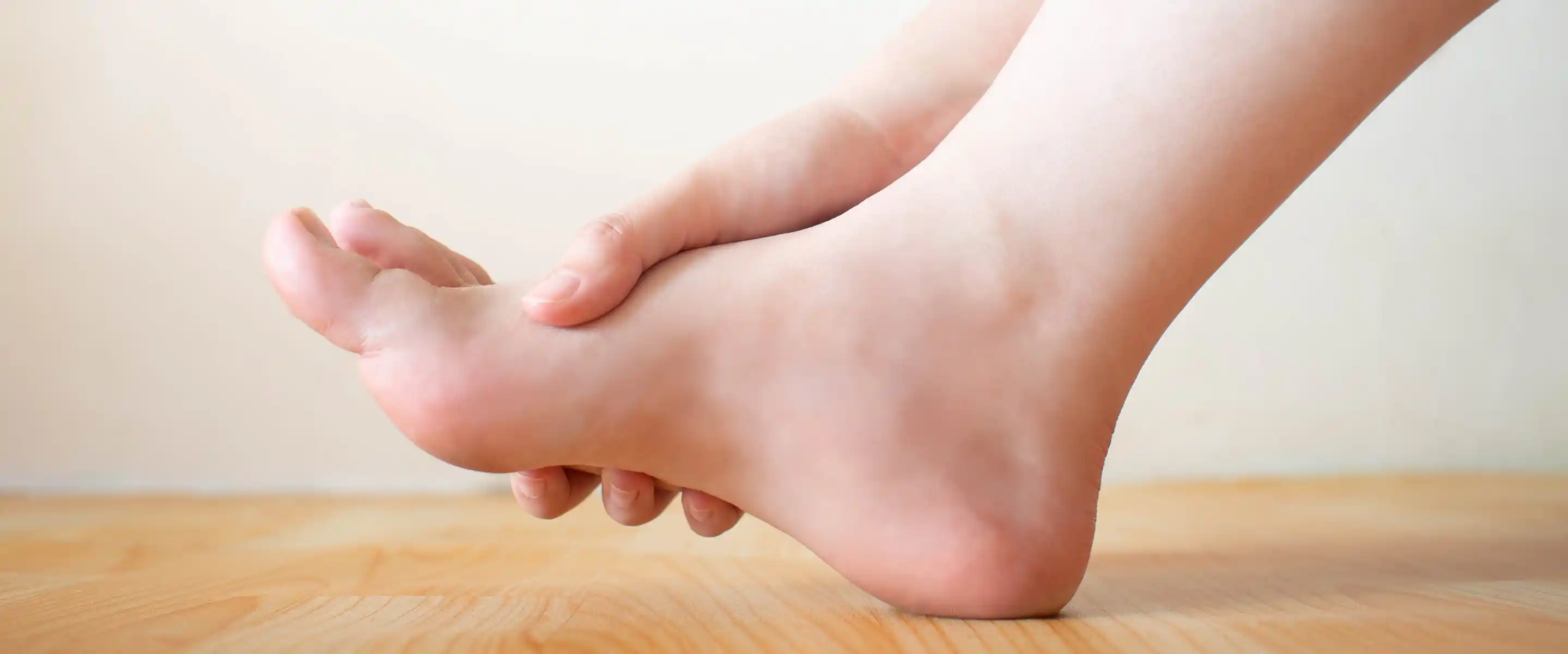
Plantar fasciitis is one of the most common causes of heel pain. Pain associated with plantar fasciitis is derived from the excess repetitive strain and inflammation on the plantar fascia -- which is a thick band of tissue that runs across the bottom of your foot and connects your heel bone to your toes.
A foot that flattens too rapidly or too much can overstretch the plantar fascia and it is the repetitive overstretching that leads to painful heels. This flattening of the arch actually occurs when the foot is rolling inward too much, also referred to as overpronation. You don’t have to have flat feet to experience this heel pain, this can occur in someone with high, low, or medium arches as well.
Plantar fasciitis is often diagnosed by a history of the disease process. Most patients note heel pain or arch pain upon arising after rest. Often, the harder they have used their feet the day before, the more tender the heel will be upon arising the next day.
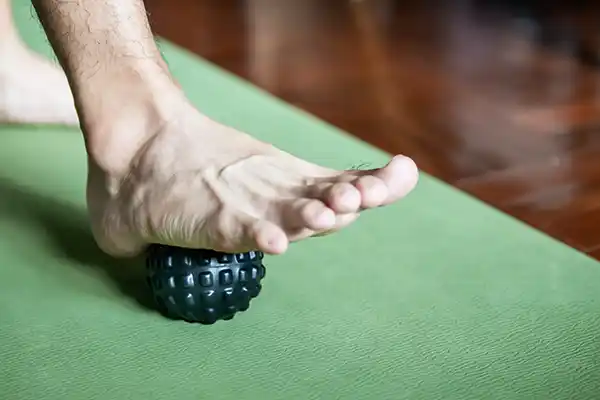
There are a few different risk factors for developing plantar fasciitis, such as:
If you exhibit any symptoms or risk factors of plantar fasciitis, the team at Dr. Ed Davis Podiatry can help you get back on your feet.
There are three components to treating plantar fasciitis, such as:
If that does not happen, it can be treated with extracorporeal shockwave therapy (ESWT), in which repeated shockwaves are applied to the fascia. This converts chronic inflammation to acute inflammation, which the body handles very well by repairing the fascia, getting rid of scar tissue, and bringing in new blood vessels (neovascularization).
ESWT can be accomplished via one or two high-energy sessions involving anesthesia, or by low energy ESWT in which 3 low energy sessions are used and no anesthesia is needed. When the plantar fascia does not respond to conventional treatments, ESWT has a high success rate of 85 - 90%, and it should be the first treatment attempted before resorting to surgery, as surgeries for the condition are rare.
If you need treatment for heel pain relief, Dr. Ed Davis can help. Your feet are one of the most used parts of your body, so trust the best podiatrists in San Antonio for all of your foot treatment needs! Visit our office at 109 Gallery Circle, Suite 119, San Antonio, Texas 78258, or call us at (210) 490-3668 to schedule your appointment today.
The treatment triad is a diagnosis-based approach to selecting the most appropriate treatment for a patient with plantar fasciitis.
According to Dr. Davis, "I coined the term 'treatment triad' for plantar fasciitis a few years back to better describe the disease process and its treatment."
The treatment triad has three "legs:"
The three "legs" of the triad thus have different "height" at different times.
Initially, the first leg, "inflammation," is by far the predominant process. As such, expect modalities such as cortisone shots to work reasonably well in the first few weeks or few months, then gradually decrease in effectiveness with time. As time goes on and if plantar fasciitis persists, the second leg must be focused on. The body can and does repair itself, and if that is not happening, then one must remove impediments, ie., find and remove the biomechanical problems preventing that from occurring. Look carefully at the second leg from 6 weeks to 6 months. Inflammation and tissue damage occurring for extended periods of time (say greater than 6 months) will compromise the body's ability to repair tissue. The tissue becomes badly scarred and devascularized. This is the point where the third leg predominates -- tissue quality.
Problematic biomechanics is best treated by a practitioner trained in that area. There are many who dabble in the area of biomechanics, from shoe fitters to retail stores, etc. Expertise in biomechanics is derived from years of study. Biomechanical issues are addressed by changes in shoegear, prescription foot orthotics, and manual therapy/physical therapy.
How is the third leg treated? The term "plantar fasciosis" is a relatively new term that specifically defines this degeneration of the fascia. Such degeneration can easily be diagnosed by use of diagnostic ultrasound or sonography. It is important that the presence or absence of fasciosis be established early on so that treatment can be adequately targeted. Surgical release of the plantar fascia was used at this stage but carries a potentially long recovery period as well as what I would consider an unacceptably high complication rate. It has been supplanted by less invasive, safer and more effective treatments to include ESWT (extracorporeal shockwave therapy), regenerative medicine and the Topaz procedure, which is also known as a partial fasciectomy via coblation. Coblation is a term meaning "cold ablation" and is a trademark of the Arthrocare Corp.

Now, one caveat: plantar fasciitis often waxes and wanes in the early stages for a number of patients, so the "stages" or "legs" Dr. Davis is discussing should not be affixed to firm time periods. For example, a patient can experience low-grade chronic plantar fasciitis for years, change jobs to one that requires more standing, and develop a bout of acute plantar fasciitis superimposed on the chronic process.
Recalcitrant or tough cases of plantar fasciitis are often due to a degenerative process of the plantar fascia, known as Recalcitrant or tough cases of plantar fasciitis are often due to a degenerative process of the plantar fascia, known as plantar fasciitis. Such cases may have been treated by invasive surgical techniques in the past, but now there are non-invasive or minimally invasive options.
The Tenex TX Procedure is a relatively new procedure in which a wand that uses ultrasound energy is inserted percutaneously (through a tiny opening in the skin), and the abnormal tissue of the fascia is removed under imaging, typically sonography. The Tenex TX procedure may be potentially less traumatic than even the Topaz Procedure since the diseased tissue can be more precisely targeted.
People's occupations often cannot be readily modified, but your foot doctor can order light or modified duty. Additionally, a doctor can do something as simple as writing a note to an employer requesting the use of preferred shoe gear. Preferred shoe gear may include shoes with a lot of cushioning and support. Use of the right prescription orthotic in the shoe can also render a shoe to become therapeutic in the standing process.
The pain experienced from plantar fasciitis has little to do with the heel striking the ground. In fact, placing something too soft under the heel will often aggravate the plantar fasciitis by letting the arch sink down lower, thereby adding strain to the plantar fascia.
Each time the foot strikes the ground, the heel hits first, followed by the ball, followed by the arch coming down. The plantar fascia is in the shape of a bowstring across the arch, acting as a shock absorption mechanism for the body. A foot that flattens too rapidly or too much can overstretch the plantar fascia and it is this repetitive overstretching that leads to painful heels.
Taking good care of your feet is the best thing you can do to try to prevent plantar fasciitis. Make sure you are always wearing proper, supportive footwear, with arch support and heel cushioning. Take precautions like standing on a rubber mat instead of a hard surface if you’re going to be standing for a long time. It is also important to stay at a healthy weight, as the more you weigh, the more pressure you place on your feet.
If you are in need of foot treatment in San Antonio, Texas, we can help. Plantar fasciitis can interrupt your daily activities, and make things like walking feel painful. Dr. Ed Davis Podiatry offers expert services in treating plantar fasciitis, and a wide array of other foot treatments to get you back on your feet. If you need a foot doctor or foot surgeon, visit our office at 109 Gallery Circle, Suite 119, San Antonio, Texas 78258, or call us at (210) 490-3668 to get more information.