
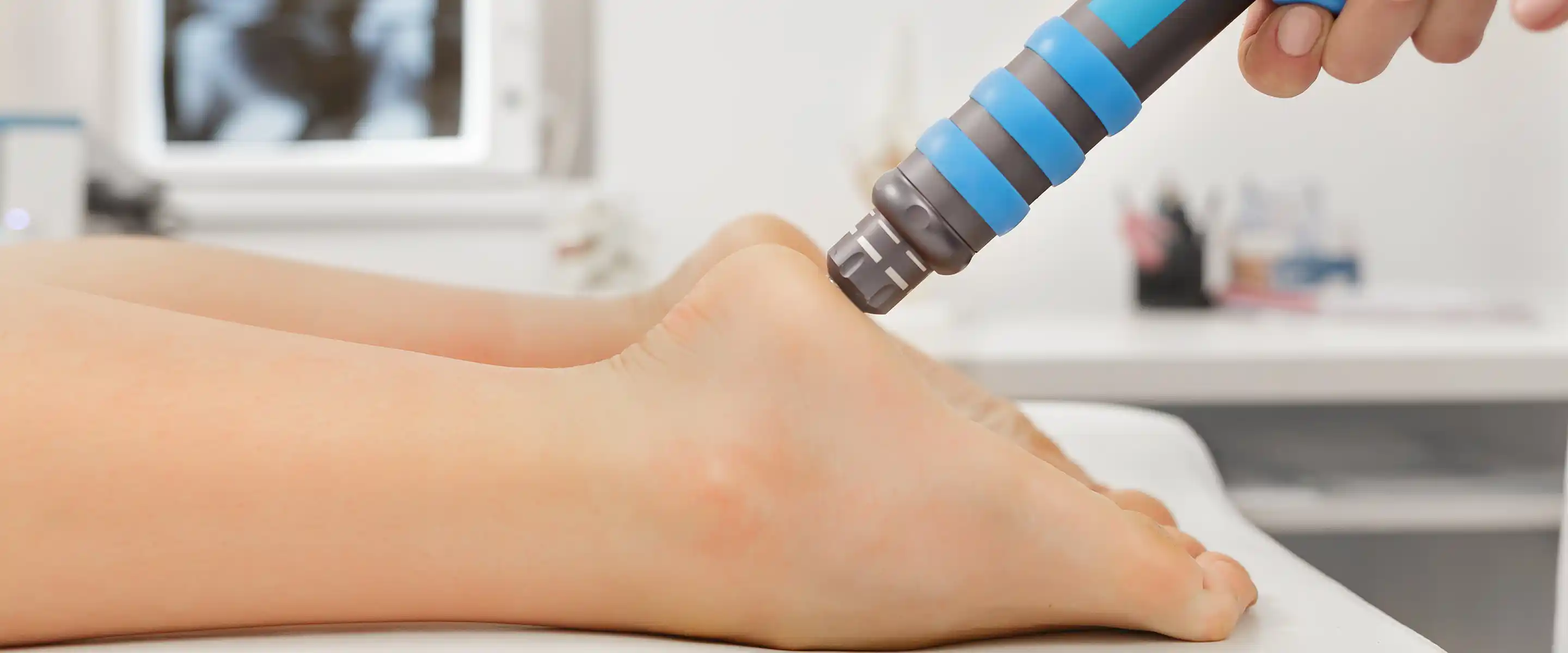
Extracorporeal Shockwave Therapy (ESWT) is a treatment modality that involves the application of pressure waves to diseased tendons and ligaments.
The term “tendinitis” refers to an inflamed tendon and the term “fasciitis” refers to an inflamed ligament, often the plantar fascia which is the large ligament that supports the foot. Inflammatory conditions often respond to anti-inflammatory medications, ice and massage and tend to be self limiting. There are cases in which conventional treatments for tendonitis and fasciitis persist. Cases of plantar fasciitis that persisted despite treatment became known as “intractable” plantar fasciitis. Surgical treatments were often utilized in that scenario.
In 2003, Harvey Lemont, DPM of the Temple University School of Podiatric Medicine, microscopically analyzed tissue taken from the plantari fascia on 50 cases of plantar fascia surgery performed for recalcitrant plantar fasciitis. He discovered that none of the tissue demonstrated inflammatory changes but showed degenerative changes instead. So called “recalcitrant plantar fasciitis” is not fasciitis at all but plantar fasciosis.
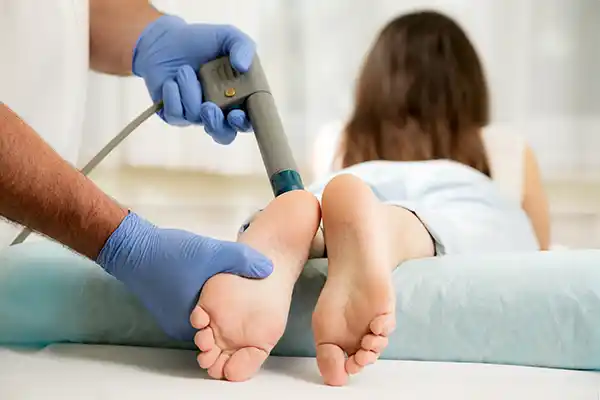
If you’re struggling with the symptoms of plantar fasciosis, ESWT may be the solution for you. If you’re ready to receive care from the best foot and ankle specialist San Antonio has to offer, schedule your appointment with Dr. Ed Davis Podiatry today.
Shock wave therapy is a non-invasive treatment method that is used for various musculoskeletal complaints, i.e., disorders affecting the muscles, bones, joints, tendons, or ligaments. The targeted application of high-energy shock waves can alleviate pain and accelerate the healing of injuries. There are two types of shock waves: radial and focused shock waves. Radial shock waves spread evenly through the tissue and are less intense. They are often used to treat superficial tissue such as tendons and muscles. Focused shock waves, on the other hand, concentrate on a specific point in the tissue and are more intense. They are often used for deeper indications or calcium deposits.
Today, doctors use shock wave therapy to treat common orthopedic medical conditions such as frozen shoulder, tennis elbow, heel pain, plantar fasciosis, Achilles tendinosis, patellar tendinosis and heel pain in plantar fasciitis. Depending on the indication, focused or radial shock waves (or both) are used.
Focused ESWT delivers precise, deep energy to specific points (bones, deep tendons) with high intensity, while Radial ESWT disperses lower-intensity energy over a wider, shallower area (superficial muscles, trigger points), making focused better for deep issues and radial for broader surface pain, though they can be combined for comprehensive treatment.
Extracorporeal shock wave therapy (ESWT) is the transcutaneous application of high-energy acoustic waves to break down abnormal
tissue or to promote tissue healing and repair. Focused ESWT involves the application of acoustic waves transmitted in a narrow or focused pattern.
First used in the early 1980s, this type of ESWT emerged as a noninvasive treatment known as lithotripsy to eliminate kidney stones. In the
decades that followed the advent of lithotripsy, researchers began to examine other potential clinical applications for focused ESWT and another
form of shock wave therapy known as radial ESWT. In contrast to focused ESWT, radial ESWT acoustic waves are transmitted in a more diffuse, radial
pattern.
As treatment successes occurred and interest in these modalities grew, researchers began exploring their full therapeutic potential.
During the 1990s and early 2000s, numerous medical research teams shared findings suggesting that ESWT could be used as a therapeutic tool.
Researchers demonstrated the use of ESWT to reduce pain and promote healing in bone, tendon, ligament and fascia in patients with musculoskeletal
disorders, and to reduce spasticity in patients with neurological disorders.
A key to understanding ESWT is based on the differences between tendinitis and tendinosis and fasciitis versus fasciosis.
Tendinitis is acute inflammation from recent overuse or injury, showing swelling, redness, and warmth, while tendinosis is chronic tendon degeneration (collagen breakdown) from repeated microtrauma, lacking significant inflammation but causing structural weakness, often developing after untreated tendinitis and requiring different, longer-term rehab focused on strengthening, not just reducing inflammation. The key difference is inflammation (tendinitis) versus degeneration (tendinosis), impacting treatment, as anti-inflammatories help tendinitis but not tendinosis. Use of injectable steroids (cortisone) can sometimes alleviate tendinitis but make tendinosis worse. Use of imaging such as diagnostic ultrasound (sonography) or MRI can readily distinguish between tendinitis and tendinosis. Sonography has the advantage of being “point of care,” that is, readily available in the doctor’s office for immediate use. It is substantially lower in cost than MRI.
Tendinosis can be treated surgically but ESWT has provided an excellent alternative, office based, offering lower cost, minimal downtime and quicker return to activities.
Fasciitis (like plantar fasciitis) involves acute inflammation of the fascia from recent overuse or injury, treated with rest, ice, and anti-inflammatories. Plantar fasciitis can also become chronic if allowed to recur or persist. The underlying biomechanical reasons for chronic repetitive straing of the fascia need be found and corrected. Chronic plantar fasciitis, if left untreated, can progress to plantar fasciosis. Fasciosis (like plantar fasciosis) is a chronic, degenerative condition where the tissue breaks down from prolonged repetitive strain. The tissue becomes thickened andstiff, occasionally brittle. Calcium deposits may occur in the fascia. Oral anti-inflammatory drugs have reduced effect on plantar fasciosis as compared to plantar fasciitis. Cortisone injections can make plantar fasciosis worse and, on occasions, lead to rupture.
Fasciosis was not well understood until the last 20 years or so and used to be called “intractable plantar fasciitis.” Patients with this malady were often treated surgically by plantar fascial release (cutting of the fascia). Such procedures often led to long recovery periods and complications to include loss of arch support and chronic pain.
Harvey Lemont, DPM (one of Dr. Davis's professors) of the Temple University School of Podiatric Medicine, in 2003, wrote a paper based on 50 patients getting plantar fascial release surgery for intractable plantar fasciitis. He asked the surgeons to provide him with tissue samples of the cut fascia. His microscopic analysis showed almost no inflammation but, rather, evidence of chronic fascial degeneration.
The benefits of shock wave therapy are many. In addition to relieving pain and accelerating healing, it can also reduce inflammation, improve blood circulation and increase the mobility of the affected area. Furthermore, the treatment generally has hardly any side effects. The targeted application of sound waves can relieve pain and speed up recovery.
However, it is important to understand the differences between radial and focused shock waves in order to choose the right treatment for the specific problem.
There are two main types of shock wave therapy: radial shockwave therapy and focused shock wave therapy. The main difference between the
two lies in the way the shock waves are generated and transmitted to the body.
In radial shock wave therapy, the shock waves are generated by a pneumatic handpiece that is placed on the area to be treated. The shock
waves then spread radially, i.e. in all directions, and can therefore treat a larger area of tissue. This is often effective for plantar fasciosis and insertional Achilles tendinosis.
Radial wave generation is generally achieved by use of a handpiece in which compressed air moves an internal projectile that transmits
power to a transmitter at the tip.
Focused shock wave therapy, on the other hand, generates the shock waves at one point and then concentrates them specifically on the area to
be treated. This enables more precise treatment and deeper penetration of the shock waves into the tissue and can be effective for treatment of fractures and
Achilles tendinosis at the “watershed’ area. The Achilles watershed area is where most Achilles tendon ruptures occur and is approximately at the level of the ankle joint.
Focused waves are generated by one of three methods:
Both types of shock wave therapy can be an effective and non-invasive treatment method for a variety of musculoskeletal disorders. The choice between radial and focused shock wave therapy depends on the type and depth of the tissue to be treated. There are advantages to discussing this with a practitioner experienced in both types of ESWT.
Plantar fasciosis means degeneration of the fascia, a slow degradation or breakdown of the fascia. Tendinosis means degeneration of a tendon. Achilles tendinosis, in which the Achilles tendon breaks down, often leads to ruptures of that tendon. The causes of tendinosis and fasciosis are not completely understood but chronic inflammation appears to be the culprit. Our bodies are designed to handle acute inflammation well but have difficulty dealing with chronic inflammation. Chronic inflammation of joints leads to degenerative arthritis. Chronic inflammation of arteries leads to atherosclerosis or narrowing of the arteries. Chronic repetitive strain on tendons and ligaments over long periods of time appears to induce degenerative processes.
Extracorporeal Shockwave Therapy (ESWT) for plantar fasciosis involves the application, in the office, of 6000 “shocks” or pressure waves to the affected fascia or tendon and is divided into three sessions about 4 to 7 days apart in which 2000 shockwaves are delivered per session. Patients can return to work the same day but are asked not to run for 24 hours after each treatment.
The fascia or diseased tendon then remodels or rebuilds over a period of 12 weeks. This process can be observed under diagnostic ultrasound. ESWT is not a symptomatic treatment although the area treated can feel better in three weeks. It is a curative treatment, and the cure can be demonstrated to occur better than 85% of the time via ultrasound.
Recent clinical meta-analyses reveal that the ESWT success rate for plantar fasciitis consistently falls between 80% and 88% for patients who haven't found relief through traditional methods. If you've spent months managing the stabbing sensation of a damaged plantar fascia, you likely feel trapped between the failure of conservative treatments and the daunting prospect of invasive surgery. It's a common frustration to see cortisone shots or generic orthotics provide only temporary reprieve while the underlying tissue degeneration remains unaddressed.
You deserve a recovery plan that's rooted in data rather than guesswork. In this review, we'll examine the evidence-based outcomes of shockwave therapy, including a 2025 study where pain scores dropped from 8.82 to 1.66 nearly 3 months after treatment. You'll discover how this technology stimulates cellular repair and why integrating a precise biomechanical assessment is the key to moving beyond symptom management toward true structural stability. We'll outline exactly what the clinical literature says about long-term satisfaction and how specialized intervention helps you regain mobility without the risks of surgical reconstruction.
Plantar fasciitis: a degenerative process (fasciosis) without inflammation
Harvey Lemont1, KristaM Ammirati, NsimaUsen
PMID: 12756315
DOI: 10.7547/87507315-93-3-234
Abstract:The authors review histologic findings from 50 cases of heel spur surgery for chronic plantar fasciitis. Findings include myxoid degeneration with fragmentation and degeneration of the plantar fascia and bone marrow vascular ectasia. Histologic findings are presented to support the thesis that "plantar fasciitis" is a degenerative fasciosis without inflammation, not a fasciitis. These findings suggest that treatment regimens such as serial corticosteroid injections into the plantar fascia should be reevaluated in the absence of inflammation and in light of their potential to induce plantar fascial rupture.
Current Sports Medicine Reports
Extracorporeal Shockwave Therapy in the Management of Sports Medicine Injuries
Schroeder, Allison N. MD1; Tenforde, Adam S. MD2; Jelsing, Elena J. MD3
Current Sports Medicine Reports 20(6):p 298-305, June2021. | DOI: 10.1249/JSR.0000000000000851
Abstract In Brief:Treatment of musculoskeletal conditions in athletes withextracorporeal shockwave therapy (ESWT) is gaining popularity as greater evidence supports its use. ESWT protocols (describing energy flux density, number of impulses, type of shockwave (focused or radial), number/frequency/duration of treatment session, area of application, and postprocedural therapy protocols) can be adjusted in the clinical setting. Protocols vary across studies, and optimal protocols for most indications are yet to be determined. ESWT can safely be used to treat various musculoskeletal conditions in athletes, including rotator cuff tendinopathy, lateral elbow epicondlyopathy, greater trochanteric pain syndrome, hamstring tendinopathy, patellar tendinopathy, Achilles tendinopathy, other tendinopathies, plantar fasciopathy, bone stress injuries, and medial tibial stress syndrome. ESWT can be used to treat in-season athletes, as it often requires no/minimal time away from sport and may result in rapid benefits. ESWT should be used in conjunction with physical therapy to facilitate longer-term gains in function and to optimize healing.
Copyright © 2021 by the American College of Sports Medicine
ESWT has stood the test of time - PMC
Raveendran K. ESWT has stood the test of time. Int J Surg.2025 Nov 1;111(11):7490-7491. doi: 10.1097/JS9.0000000000003823. Epub 2025 Oct 29. PMID: 41359021; PMCID: PMC12626573.
In 2015, the International Journal of Surgery published a Special Issue on Shockwave treatment[1] withthe assistance of the International Society for Medical Shockwave Treatment (ISMST).
(Note from Dr. Davis:I was the editor for that Special Issue, and I wrote the editorial titled “ESWT is a force to be reckoned with” [2]. This issue had 20 papers, mostly review papers, and all the articles were invited from experts in the field of shockwave medicine. This special issue was well reviewed and cited.
In 2024, I mooted the idea of a second Special issue, but this time we opened it to all members of the ISMST, as I wanted original articles. ESWT is now a worldwide “phenomenon” with shockwave societies in many countries. The research in ESWT has multiplied over the last 10 years, including basic science and clinical research with many high-quality studies. The clinical indications have also widened with ESWT being used for cardiac and neurological diseases.
The International Journal of Surgery has also evolved over the last 10 years into an extremely reputable journal with a high impact factor ranking second among all surgical journals. All submissions were subjected to a rigorous editorial process, and only 13 articles were accepted. There are five basic science articles and eight clinical studies.)
The working mechanism of shockwave has been studied extensively. Othmar Josef Wess[3] developed a model on momentum transfer at the different layers of biological tissue. He concluded that this mechanism is the basis for mechano-transduction and mechano-sensory-transduction.
Fan Hu et al [4] used nano-motor composite microneedles as a transdermal delivery system for zoledronic acid. The shockwaves were used to deliver zoledronic acid and calcium to low bone density areas to improve the bone density. This study was done in ovariectomized mice. This novel transdermal system could reduce the systemic side effects of intravenous zoledronic acid as well as to target low BMD areas if clinically applied in the future.
This third article by Zong-Sheng Wu et al [5] investigated the mechanism by which low-energy shockwaves can improve cystitis in a rat model. miRNAs are involved in bladder inflammation, and low-energy shockwaves can mitigate their effects. ESWT has been clinically used for interstitial cystitis/bladder pain syndrome in patients. The findings in a rat model also showed that shockwaves can improve intravesical drug retention.
Jiunn-Jye Sheu et al[6] showed that pretreatment of mesenchymal stem cells with shockwaves could improve left ventricular ejection and inhibit left ventricular remodeling in mini-pigs with old myocardial infarction. Elaborate in vivo and in vitro studies showed angiogenesis in shockwave-treated animals with improved cardiac function as compared to the control group of mini pigs.
Spinal cord injury is a debilitating condition without any effective treatment. Jai Hong Cheng et al[7] have used EWST in the rat model showing significant improvements in motor recovery, tissue regeneration, anti-inflammatory effects and mitochondrial protection. A multi-center prospective randomized trial is still ongoing and results are awaited.[8]
Shu-Jui Ko et al[9] studied the combination of subacromial hyaluronic acid (HA) injection with ESWT in treating rotator cuff lesions without complete tears. Patients were divided into three groups, and an MRI was done before the study and 12 months later. ESWT provides additional benefits when combined with HA injections for patients with partial rotator cuff lesions.
A prospective study on the use of ESWT for calcific tendinitis of the shoulder improved symptoms, reduced calcification, enhanced tissue perfusion and promoted angiogenesis and BMP7 activity. Jai Hong Cheng et al[10] lookedat both radiolucent and radio-dense calcifications and reinforced ESWT as an effective treatment for calcific tendinitis of the shoulder.
Jakub Katolicky et al [11] ina prospective study studied 21 athletes with chronic patella tendinopathy. ESWT was applied over four weekly sessions. Ultrasound evaluation showed improved results in clinical symptoms and tendon structure.
A prospective randomized study by Tomas Nedelka etal[12] wasconducted in 128 patients with chronic lumbar facet syndrome. Patients were randomized to receive ESWT or sham therapy. They were reviewed at 6 and 12 months, with a significant reduction in VAS scores. MRI done showed a reduction of bone marrow edema in the treated group as opposed to the sham group. There were no adverse effects reported.
Yoon Soo Cho et al[13] investigatedthe effect of ESWT on the skin microbiome of burn patients. This retrospective study on 19 patients with burn scars who were treated with ESWT weekly for 3 months showed that ESWT enhances microbial diversity and modifies the microbial community structure in burn scars. This contributes to improved skin health and recovery aiding scar remodeling.
The use of ESWT in spastic cerebral palsy has been well documented. This meta-analysis by Thijs Wim Janssen et al[14] looked at 12 randomized controlled trials. The combined study population included 421 children. ESWT showed positive effects across multiple parameters in children with spastic cerebral palsy.
Shock waves are high-energy, audible acoustic or soundwaves. They are characterized by a rapid increase in pressure and a short pulse length. They occur in our everyday lives, for example, when aircraft break the sound barrier.
Shock waves have been used in medicine since 1980. Originally, the then-new procedure was introduced to remove kidney and gall stones without surgery – which was successful and revolutionized the treatment of these complaints. Before use of ESWL(shockwave therapy for kidney stones), surgical treatment had a relatively high complication rate. The second area of application was the treatment of poorly healing bone fractures, so-called pseudarthroses.
Due to these successes, more and more research was done on the effect of shock waves on the human body. Subsequently, it was quickly discovered that the procedure is also suitable for the treatment of numerous painful diseases of the musculoskeletal system. Since the beginning of the 1990s, this area of application has become increasingly important and has since proven its worth, including in top international sports.
It is important that the initial patient exam be able to distinguish between tendinitis and tendinosis, fasciitis and fasciosis. Shockwave treatment for plantar fasciitis generally does not work for fasciosis or suffice for Achilles tendon treatment. The advent of office based high resolution ultrasound allows the clinician to immediately render an accurate diagnosis. We utilize the Sonosite Edge, which provides high resolution images of the fascia, tendons, ligament and even nerves.
While some patients experience a slight soreness after their treatment, this pain subsides quickly, and the procedure itself is generally painless.
Yes. For many patients who opt for extracorporeal shockwave therapy, surgery becomes unnecessary and pain relief can be achieved without pain and with significantly reduced cost and downtime. Learn more about the benefits of ESWT on our blog!
If you are looking for the best podiatrist in San Antonio, Texas, you’ve come to the right place. Foot and ankle ailments shouldn’t put you on the sidelines. If you or a loved one are in need of a foot doctor, visit our office at 109 Gallery Circle, Suite 119, San Antonio, Texas 78258, or call us at (210) 490-3668 to get more information.