
The Biomechanical Link: Why Plantar Fasciitis Requires Functional Correction
Plantar Fasciitis is often misunderstood as simple inflammation. In reality, it is a biomechanical failure. The plantar fascia is not merely a passive band of tissue; it is a critical, tension-bearing structure essential for proper foot function. When the mechanics of your gait are flawed, this structure is subjected to repetitive micro-tearing, leading to chronic pain and tissue degeneration. This is why superficial treatments that only address symptoms, like simple cushioning, consistently fail to provide lasting relief.
The root of the problem lies in functional instability. Abnormal foot motion, particularly excessive pronation, causes the architectural arch of the foot to collapse during critical phases of the gait cycle. This collapse places an immense tensile load on the plantar fascia, pulling at its insertion point on the heel bone (calcaneus). To resolve the pain permanently, we must correct the underlying mechanical flaw, not just pad the symptom. This requires a medical intervention designed to control motion and restore proper function from the ground up.
- The Plantar Fascia as a Tension-Bearing Structure: It acts like a tie-rod, maintaining the longitudinal arch of the foot. When other structures fail, it takes on excessive force, leading to injury.
- The Failure of the 'Windlass Mechanism': Abnormal pronation and other biomechanical faults prevent the fascia from tightening properly during push-off, causing arch collapse and strain.
- Why Cushioning Alone is Insufficient:Soft inserts may provide temporary comfort, but they do not stop the pathological stretching and micro-tearing of the fascia. The degenerative cycle continues unabated.
The Role of Equinus (Tight Calf Muscles): A limited range of motion in the ankle, known as equinus, forces the foot to over-pronate to compensate. This significantly increases the strain on the plantar fascia. While orthotics manage the resulting foot instability, equinus itself must be addressed through targeted physical therapies.
Understanding the Windlass Mechanism
The Windlass Mechanism is a fundamental biomechanical function that illustrates the foot's elegant engineering. As you prepare to push off, the extension of your big toe pulls the plantar fascia taut, much like winding a cable. This action actively raises and stabilizes the arch, creating a rigid lever for efficient propulsion. In a healthy foot, this process is seamless, absorbing and returning energy with each step. However, biomechanical flaws can cause this mechanism to collapse during the gait cycle, preventing the arch from becoming rigid and leading to a cascade of tissue strain. The failure of the windlass mechanism directly increases tensile stress at the fascia's insertion point, causing the sharp, localized pain of plantar fasciitis.
Abnormal Pronation vs. Normal Shock Absorption
It is crucial to distinguish between normal and abnormal pronation. Normal pronation is a natural, necessary motion where the foot rolls slightly inward to absorb shock upon impact. Pathological or excessive pronation, however, is a structural collapse. The subtalar joint, which governs this motion, allows the arch to flatten too much and for too long, placing the plantar fascia and other structures under constant, damaging tension. Medical-grade custom orthotics act as a 'floor' beneath the subtalar joint, preventing this over-pronation. By establishing a precise boundary for motion, they allow for normal shock absorption while blocking the pathological collapse that causes injury not only in the foot but also upstream in the knees, hips, and lower back.
Abnormal Supination or Oversupination
Excessive outward rolling of the foot creates torsional strain on the fascia (twisting strain), which can damage the fascia and create pain. Arch supports will make the foot roll out more, increasing supination. Only a true custom foot orthotic created by a podiatrist with expertise in biomechanics in San Antonio can address this issue properly.
Medical-Grade Custom Orthotics vs. Retail Insoles: A Comparative Analysis
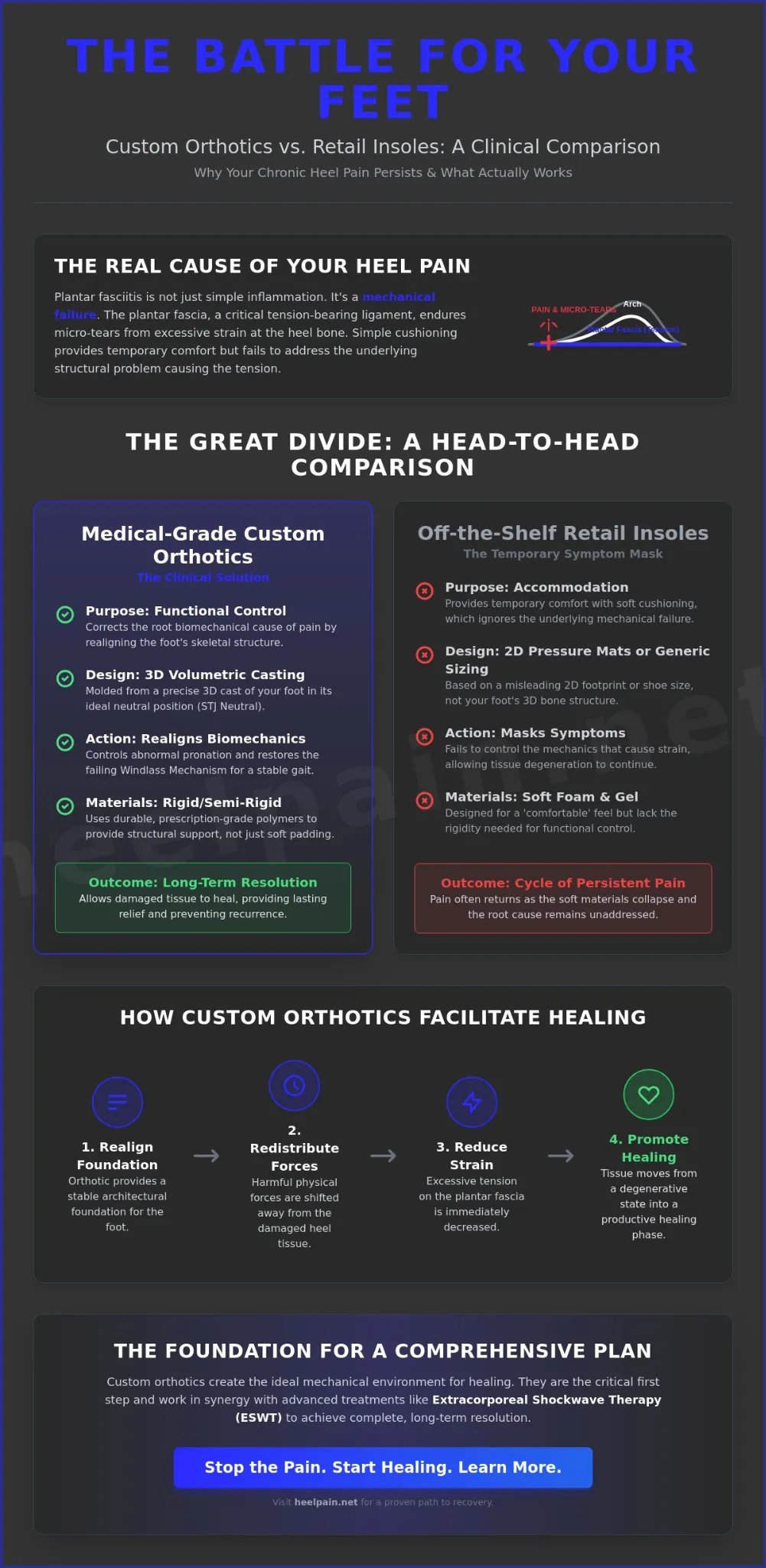
The distinction between a medical-grade custom orthotic and an over-the-counter (OTC) insole is not a matter of degree; it is a fundamental difference in purpose, material, and design. Retail inserts are built for 'accommodation'—providing soft cushioning to temporarily alleviate pressure. In contrast, prescription custom orthotics are designed for 'functional control'—structurally realigning the foot to correct the pathological motion that causes the injury in the first place.
This difference is evident in their construction. OTC insoles are typically made from compressible foam or gel, which lose their shape and supportive properties quickly. Medical-grade orthotics are fabricated from durable, non-compressible materials like graphite or polypropylene, engineered to maintain their corrective prescription for years. Furthermore, the 'one-size-fits-most' approach of retail products, with generic arch heights, can be counterproductive or even harmful. A so-called 'arch support' that doesn't perfectly match your foot's specific biomechanical needs can introduce new points of pressure and strain. The 'retail kiosk' myth, which suggests a 2D pressure scan is equivalent to a medical prescription, is particularly misleading. Such scans only capture static pressure points; they do not and cannot capture the dynamic, three-dimensional motion of the foot during gait, which is essential for a true functional correction.
The Limitations of Over-the-Counter (OTC) Inserts
For individuals with significant biomechanical faults, OTC inserts are not just ineffective; they can be detrimental. A generic arch support placed under a foot with a specific type of instability may actually increase strain on the plantar fascia by creating an improper fulcrum. The materials used in these products—typically ethylene-vinyl acetate (EVA) foam or gel—undergo rapid compression. The perceived support felt on day one can diminish by more than 50% within a few weeks of active use, returning the foot to its pathological state. OTC inserts are most likely to fail for patients with moderate to severe over-pronation, rigid high arches, or compensatory gait patterns, as these conditions require precise, non-negotiable control that a generic device cannot provide.
Functional Orthotics: The Prescription Difference
A prescription orthotic is a medical device, plain and simple. It is prescribed by a podiatrist to treat a specific pathology, much like a physician prescribes medication for a specific illness. The design is based on a comprehensive biomechanical evaluation and a precise 3D model of your foot held in its ideal functional position (subtalar joint neutral). This allows for the incorporation of specific corrective elements, such as 'posts' and 'wedges,' which are extrinsic additions that tilt and realign the heel bone (calcaneus) and other key structures. This level of control is impossible to achieve with an off-the-shelf product. While the initial investment is higher, the long-term return on investment (ROI) is far greater. A single pair of medical-grade orthotics can last for many years, providing consistent, reliable correction, whereas a patient might spend hundreds of dollars over the same period on retail inserts that offer little more than false hope and temporary cushioning.
The Anatomy of a Professional Biomechanical Evaluation in San Antonio
The creation of a true custom functional orthotic begins not with a mold, but with a diagnosis. A comprehensive biomechanical evaluation is a detailed investigation into the root cause of your pain, led by a specialist trained to identify subtle mechanical deviations. This clinical examination goes far beyond simply identifying where it hurts; it analyzes how your joints move, how your muscles function, and how your entire lower extremity interacts with the ground during gait.
At our San Antonio clinic, Dr. Ed Davis performs a meticulous assessment that forms the foundation of your treatment plan. This process is systematic and evidence-based, ensuring that the resulting orthotic is not just 'custom-fit' to your foot's shape, but is precisely engineered to correct its specific functional deficits.
Non-Weight-Bearing Joint Assessment: We manually test the range of motion (ROM) of every critical joint in your foot and ankle to identify restrictions or excessive mobility that contribute to instability.
'STJ Neutral' Casting: The most critical step is capturing a 3D model of your foot while the subtalar joint (STJ) is held in its optimal neutral position. This is the corrected position we want the orthotic to maintain.
Dynamic Gait Analysis: We observe you walking to see how your foot functions in motion. This reveals compensatory patterns and timing errors in the gait cycle that a static examination cannot detect.
Expert Identification of Deviations: With years of specialized experience, Dr. Davis can identify subtle mechanical flaws—like a delayed heel lift or an early unlocking of the midtarsal joint—that are primary drivers of chronic plantar fasciitis.
Range of Motion and Muscle Strength Testing
A key part of the evaluation involves assessing the kinetic chain. We critically test ankle dorsiflexion (the ability to pull your foot upward) to diagnose conditions like gastrosoleus equinus—clinically tight calf muscles. This condition is a major contributor to plantar fasciitis, and identifying it is essential for a complete treatment plan. We also evaluate the mobility of the first metatarsophalangeal joint (the big toe joint), as its flexibility is vital for the Windlass Mechanism to function correctly.
During the clinical exam, muscle imbalances are identified by comparing the strength and function of opposing muscle groups to isolate specific weaknesses that lead to biomechanical compensation and overload.
Precision Casting and 3D Modeling
Whether using traditional plaster casting or state-of-the-art 3D digital scanning, the principle remains the same: the foot must be captured in its corrected, non-weight-bearing, subtalar joint neutral position. This is a critical distinction from retail kiosks that take an impression of your foot in its dysfunctional, weight-bearing state. Capturing the foot in its collapsed position and placing a support under it merely accommodates the deformity; it does not correct it. The precise 3D data from our scan or cast is then sent to a specialized laboratory, where it is used to fabricate the orthotic shell. This shell becomes the foundation for a medical device engineered to control your specific biomechanical flaw.
Beyond Cushioning: How Custom Orthotics Facilitate Tissue Healing
The primary therapeutic function of a custom orthotic is to create an environment where the plantar fascia can heal. It achieves this not by adding cushioning, but by providing structural stability that reduces the pathological tensile stress on the tissue. By preventing the arch from collapsing and controlling abnormal motion, the orthotic effectively stops the repetitive micro-tearing at the fascia's insertion on the medial tubercle of the calcaneus. This allows the body's natural healing processes to move the tissue out of the chronic 'degenerative' phase (fasciosis) and into a 'reparative' phase.
A common objection is the fear that wearing orthotics will make the feet 'weak' or 'lazy.' This is a misconception. Custom functional orthotics do not immobilize the foot; they control and optimize its motion. By preventing pathological movement, they allow the intrinsic muscles of the foot to function within their normal, intended range, which can actually lead to improved neuromuscular efficiency over time. Furthermore, by stabilizing the primary biomechanical fault, orthotics prevent the development of 'compensatory' injuries in the midfoot, ankle, and even the knee, which often arise as the body tries to adapt to the initial instability.
Mitigating the Chronic Inflammatory Cycle
When plantar fasciitis persists for months or years, the condition often transitions from acute inflammation (fasciitis) to a state of chronic tissue degeneration (fasciosis). In this state, the tissue is characterized by disorganized, poor-quality collagen fibers and a lack of healthy blood flow, not active inflammation. To heal, the tissue needs a period of relative rest from the forces that caused the breakdown. Custom orthotics provide this 'active rest' by offloading the fascia during daily activities, allowing for tissue repair to occur without requiring total immobilization. Consistent wear, especially during the initial healing phase, is critical to breaking the chronic cycle of degeneration and pain.
Orthotics as a Preventive Tool for Recurrence
Once the damaged tissue has healed, the role of the orthotic shifts to prevention. Because the underlying biomechanical flaw—such as over-pronation or a collapsing arch—is often a permanent structural trait, removing the orthotic support would simply allow the pathological forces to return, leading to a recurrence of the injury. By continuing to wear the orthotics, you are correcting the root cause of the problem with every step. This provides long-term protection not only for the plantar fascia but also for the heel's natural 'fat pad,' which can be eroded by the constant, abnormal pressures of a dysfunctional gait. For San Antonio residents with active lifestyles or jobs that require long hours of standing, custom orthotics are an essential tool for ensuring that plantar fasciitis does not return.
Long-Term Resolution: Integrating Orthotics into a Comprehensive Plan
While custom orthotics are a cornerstone of effective plantar fasciitis treatment, they achieve their best results as part of a comprehensive, multi-modal treatment plan. Think of the orthotic as the 'structural foundation.' It corrects the mechanical platform of the foot, creating the stability needed for other therapies to be successful. Attempting to treat the damaged tissue without first correcting the underlying mechanics is like trying to patch a crack in a wall with an unstable foundation—the problem will inevitably reappear.
For patients who have 'tried everything' without success, this integrated approach is often the key to a final resolution. It addresses the problem from multiple angles simultaneously: the orthotic corrects the biomechanics, advanced therapies stimulate tissue repair, and targeted stretching protocols improve flexibility in related structures. This synergy is what moves a patient from a cycle of temporary relief to a state of permanent recovery.
The Structural Foundation: Custom orthotics are the primary tool for correcting the root biomechanical cause of the stress on the plantar fascia.
Synergy with Advanced Therapies: They create the stable environment necessary for treatments like Extracorporeal Shockwave Therapy (ESWT) to effectively regenerate tissue.
Essential Adjuncts: A complete plan includes specific stretching protocols for the calf muscles and Achilles tendon, as well as guidance on proper footwear.
A Roadmap to Recovery: This integrated strategy provides a clear path forward for patients frustrated by the failure of isolated, single-modality treatments.
The Synergy of Orthotics and ESWT
Extracorporeal Shockwave Therapy (ESWT) is a powerful regenerative treatment that uses acoustic waves to stimulate blood flow and trigger the body's natural healing factors within the degenerated fascial tissue. However, if the patient continues to walk with the same flawed biomechanics that caused the injury, they are effectively re-injuring the tissue between treatments. This is where the synergy becomes clear: ESWT stimulates healing at a cellular level, while the custom orthotics protect the tissue from pathological strain, allowing the regeneration to proceed uninterrupted. Treating the tissue with ESWT without correcting the mechanics with an orthotic often leads to relapse, as the fundamental cause of the tissue stress remains unaddressed.
Selecting the Right Footwear for Your Orthotics
Pairing your custom orthotics with the right shoes is critical for maximizing their effectiveness. Since the orthotic provides all the necessary correction and control, you should look for a 'neutral' shoe without aggressive built-in stability features, as these can interfere with the orthotic's prescription. The most important feature is a firm heel counter and a removable factory insole. This allows the custom orthotic to sit flat and deep within the shoe, ensuring a proper fit and optimal function. By combining a supportive, well-fitting neutral shoe with your prescribed medical device, you create the ideal environment for pain-free, mechanically sound movement.
